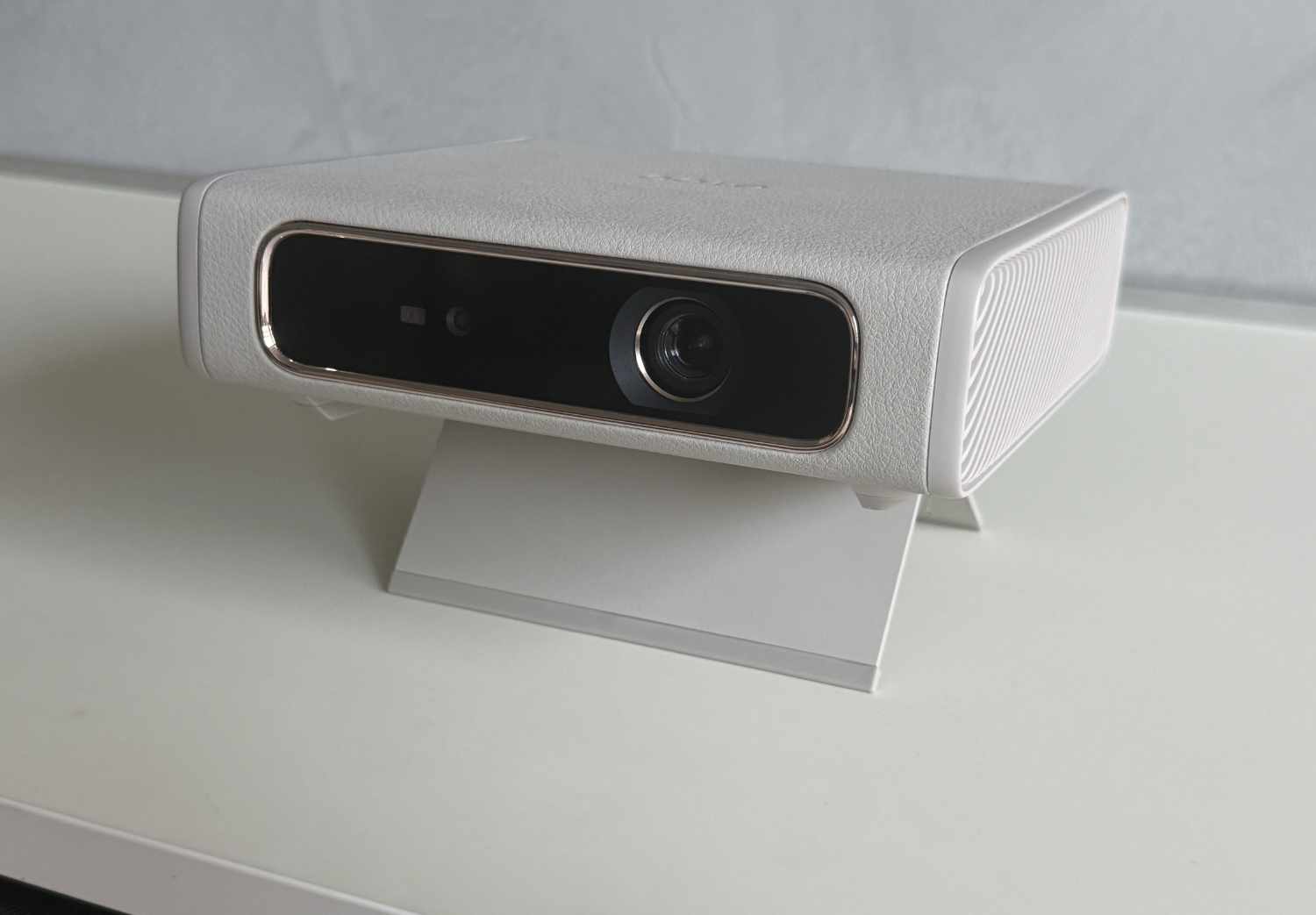
As mentioned earlier, the Etoe Dolphin 2 is powered via USB-C. In addition to the included USB-C power adapter, the projector can therefore also be powered by a power bank or a power station, for example when on the go. The only requirement is that the power source provides sufficient power. We measured power consumption at the adapter at just under 50 W at maximum brightness. At minimum brightness, it was just under half that. Measured directly at the projector’s USB-C port, the figures were a few watts lower in each case due to conversion losses in the power adapter. This means a 100-Wh power bank is sufficient for a two-hour movie, even at maximum brightness.
Alternatively, thanks to its built-in 54-Wh battery, the projector can also be operated completely independently of an external power source. The manufacturer specifies up to two hours of battery life. How long the device actually lasts depends, of course, on the settings—primarily the brightness. In our hands-on test, the Etoe Dolphin 2 lasted just over an hour while streaming at full brightness. That is enough for an episode of a series, but not for a movie. Here, too, reducing the brightness and using local playback extend the runtime. Since power consumption at minimum brightness is only about half as high, the promised two hours are possible—though with a dark picture.
About five minutes before the battery ran out, a notification window popped up—though it was in French instead of the selected German language. Unfortunately, we could not find any other battery indicator. There is a “Battery” menu item in the settings, but unfortunately there is nothing behind it. Charging with the included power adapter takes under 2.5 hours.
We measured the fan noise at around 32 dB from a distance of 1 m. A continuous rushing noise can be heard, but it is not particularly loud and quickly fades from notice while watching a movie.